
Porosity and hair care
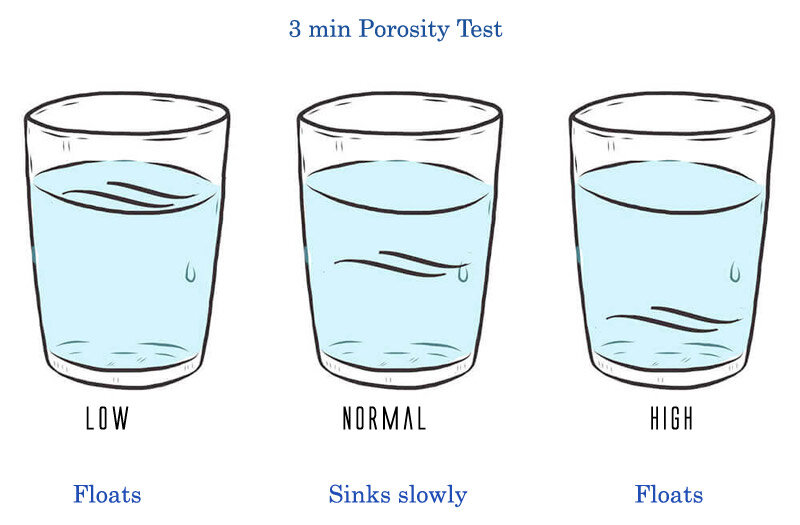
You may have heard the term ‘porosity’ when it comes to hair, but unless you were formally trained, you might not be familiar with what it really means. Understanding what porosity means and how you can apply it to the care of your hair can be very handy. First, what is Porosity?
Porosity refers to hair’s ability to absorb moisture. How absorbent depends on your natural texture, color history, styling, and degree of environmental exposure. The usual suspects that damage hair–bleach, excessive heat, sun and salt water–not only leave hair weakened, they also increase hair’s porosity. In healthy hair, the cuticle is closed, protecting the hair shaft.How do I know if I have porous hair?There are two methods you can use to find out how porous your hair is.The Float Test: Take a couple of strands of hair from your comb or brush and drop them into a bowl of water. Let them sit for 2-4 minutes. If your hair floats, you have low porosity. If it sinks, you have high porosity.The Slip'n'Slide Test: Take a strand of hair and slide your fingers up the shaft (toward the scalp). If you feel little bumps along the way, this means that your cuticle is lifted and that you have high porosity. If your fingers slip smoothly, then you have low porosity hair.
Still not sure? Here are characteristics of low, normal, and high porosity when it comes to hair:Low porosity characteristics:Products sit on your hairWashing and drying takes longerProduct buildup is more common
Normal porosity characteristics:Hair has high elasticityVery little maintenance is required for your hairHair easily accepts and retains moistureHair can be colored with good results
High porosity characteristics:Hair easily absorbs water and productsHair often looks and feels dryHair can be frizzyHair dries quickly
You might be wondering what this all means when it comes to coloring your hair...When the cuticle of the hair is frayed and lifted, as in the case of highly porous hair, color penetrates very easily and hair color formula can further weaken strands. On the other side of the spectrum, hair that’s low in porosity, while slick and smooth, repels color and often requires longer processing times. For those with high porosity, your time for color may be shorter as we want to mitigate more damage to your hair. For those with low porosity, your hair may take longer to process. Tips on managing your hair type:Low porosity hair care:Apply products to damp hair to allow them to sink in vs. on drenched hair.Use some heat conservatively to open the cuticle and allow for treatments to soak in.Try using an Apple Cider Vinegar wash to eliminate product build-up. We love Acid Wash from r+co.
Normal porosity hair care:Use a deep conditioner or mask to maintain the health of your hair. We love r+co’s Television Mask.
High porosity hair care:Allow your hair to air dry as heat can further damage your hair.Incorporate a treatment or deep conditioner into your haircare routine. We loveRinse your hair with cold water to seal your cuticle.Detangle your hair with a detangler and a Wet Brush to minimize further damage.
We hope that this blog post provided a better understanding of your hair type to better care for your strands!Dandruff myths and realities
Dandruff is such a common scalp condition that we see with our clients - partly because there are many myths concerning its causes and how to manage it.
Yeah, dandruff can be embarrassing and annoying, but so many people experience dandruff issues at some point in their life.

Dandruff is such a common scalp condition that we see with our clients - partly because there are many myths concerning its causes and how to manage it. Yeah, dandruff can be embarrassing and annoying, but so many people experience dandruff issues at some point in their life. Keep reading to get to the root of the problem and find out myths vs. realities when it comes to dandruff...Myth #1: Dandruff comes from having a dry scalp.Verdict: False.It’s actually the opposite. Having an oily scalp is more likely to lead to flakes. Malassezia are a type of fungus and they are lipophilic, which means they love the oil (sebum) your skin produces and thrive when there’s more of it. Myth #2: You should scratch away dandruff before washing your hair.Verdict: FalseDislodging flakes with your fingernails or a comb is not the best strategy to get rid of dandruff. If you feel like you have to dislodge them, you may be dealing with something different than dandruff. You may have a different scalp condition. Being so harsh on you scalp can also be painful and can cause infection due to open skin. Our advice: don’t do it!Myth #3: You should wash your hair less often if you have dandruff.Verdict: FalseRevisiting myth 1 here: being that oily scalp leads to dandruff, it is best to shampoo your hair daily. Myth #4: You don’t need to exfoliate your scalp.Verdict: False.Using an exfoliator once or twice a week will help get rid of unwanted dandruff because is lifts away flakes and helps return the rate of skin cell turnover on the scalp to a normal level. We love r+co’s Crown Scalp Scrub. The purifying and soothing scrub will detox, cleanse and re-balance your scalp and is excellent for sensitive and/or oily skin.If following the steps above do not work for you, visit your doctor, as you may have a scalp condition such as psoriasis or eczema. How to choose the best shade of blonde
Are you thinking of going blonde? Or maybe switching the tone of your blonde hair? Deciding between the different blonde tones is something to consider when you go lighter. How? Here’s how to choose the perfect blonde hue for you:

Are you thinking of going blonde? Or maybe switching the tone of your blonde hair? Deciding between the different blonde tones is something to consider when you go lighter. How? Here’s how to choose the perfect blonde hue for you: ID the tone of your complexion by checking your wrists. If your veins are blue or purple, you are most likely cool-toned. If your veins are green, you are most likely warm-toned. If you’re in between, you are most likely neutral-toned.Match yourself with a celeb. When you're looking for A-list color inspiration, try to pick out those with similar skin and eye coloring to your own. This process will give you an idea of how a color and/or tone will look on you.Take into account the depth of your eye color – how much of a contrast do you want? Soft, multi-tonal shades complement lighter eye colors, whereas deeper, richer blondes flatter a darker eye color.Think about maintenance – an all over platinum blonde needs regular trips to the salon whereas a more ombre or rooty blonde look is far more low maintenance.
The shades:Cool Blonde
Shades include: platinum, ice, silver, ash, sand, beige, champagneWho it's best suited for: Cool blonde shades are gorgeous on those with porcelain skin and those with red or pink undertones since those icy hues tend to neutralize redness. Those with blue or gray eyes look great with cool, ashy blonde tones too. 
Warm Blonde:
Shades include: gold, caramel, amber, honey, butterscotchWho it's best suited for: If you have fair skin with cool undertones, warm tones like buttery blonde look beautiful because they neutralize blue and purple in the skin. Warmer tones also look radiant on people with olive and deeper skin tones.Of course not all rules need to be followed, so go with whatever tone or shade that makes YOU feel best! 